TOPCon vs HJT vs PERC in 2026: A Buyer's Decision Table
TOPCon, HJT and PERC compared for 2026 buyers: module efficiency, temperature coefficient, price per watt, lead times and a project-type decision table.
In 2026, TOPCon is the default choice for most importers: mainstream modules sit at 22.0–23.2% efficiency, cost roughly $0.085–0.105/W FOB China, and ship in volume on 4–8 week lead times. HJT wins only where roof area is scarce or heat is extreme (module efficiency 22.5–23.5%, temperature coefficient around -0.24 %/°C). PERC remains buyable for budget-capped retrofit work at 20.5–21.5% module efficiency, but its supply base is shrinking.
Where Each Technology Sits in 2026
In 2026 the market has settled into a three-tier structure: TOPCon is the volume workhorse, HJT is the high-efficiency specialist, and PERC is a declining legacy platform.
The shift happened faster than most forecasts expected. Passivated-contact TOPCon went from pilot lines to more than half of global cell capacity in roughly three years, mainly because it could be retrofitted onto existing PERC lines with added deposition steps. HJT needed new low-temperature lines, indium-based transparent conductive oxide, low-temperature silver paste and different stringing equipment — a full retool, which is why its capacity share stayed in the low double digits despite a higher efficiency ceiling.
TOPCon
Mass-production cell efficiency runs 25.3–26.4%, giving 22.0–23.2% at module level on 182 mm or 210 mm formats. Bifaciality is 80–85%, so it suits trackers and elevated mounting. It works with POE, EPE and co-extruded encapsulants, which keeps BOM options open.
HJT
Cell efficiency is typically 25.5–26.8% and module 22.5–23.5%, with bifaciality of 85–90%. The trade-off is process sensitivity: the TCO layer needs indium, metallisation must cure below 200°C, and the module needs UV-cut encapsulation to control UV-induced degradation. Those are BOM-discipline problems rather than physics problems — but they are why two HJT suppliers can quote very different prices.
PERC
Cell efficiency sits at 23.0–23.5% and modules at 20.5–21.5%. Bifacial PERC exists but rear gain is modest at around 70% bifaciality. Capacity is being retired or converted, and several tier-one lines no longer quote PERC in volume.
TOPCon vs HJT vs PERC: Efficiency, Degradation and Temperature Comparison
HJT wins every headline number that drives hot-climate yield, TOPCon is close enough that price decides most orders, and PERC loses on all three metrics.
| Parameter | TOPCon | HJT | PERC |
|---|---|---|---|
| Cell efficiency (mass production) | 25.3–26.4% | 25.5–26.8% | 23.0–23.5% |
| Module efficiency (72-cell class) | 22.0–23.2% | 22.5–23.5% | 20.5–21.5% |
| Temperature coefficient (Pmax) | -0.29 to -0.32 %/°C | -0.24 to -0.26 %/°C | -0.34 to -0.37 %/°C |
| First-year degradation | 1.0–1.5% | 0.8–1.0% | 2.0–2.5% |
| Annual degradation after year 1 | 0.40–0.45% | 0.25–0.35% | 0.55% |
| Bifaciality factor | 80–85% | 85–90% | ~70% |
| PID behaviour (IEC 62804) | Low risk with POE/EPE | Low, but UV-cut encapsulant required | Moderate, humidity-sensitive |
Read the temperature coefficient column as money. At 35°C ambient, cells run near 60–65°C, which is 35–40 K above the 25°C STC point. PERC at -0.35 %/°C loses roughly 13% of rated power there; TOPCon at -0.30 loses about 11%; HJT at -0.25 loses about 9%. The method behind this arithmetic is set out in our guide to temperature coefficient in hot climates.
Degradation compounds the gap. Over 25 years, 0.55%/yr for PERC against 0.40%/yr for TOPCon and 0.30%/yr for HJT leaves roughly 4 percentage points of extra yield in the TOPCon column. STC efficiency alone does not capture this: if you are comparing bids seriously, ask for an IEC 61853-1 energy rating rather than an STC number, because low-irradiance and spectral response reorder the ranking at real sites.
Is PERC Still Worth Buying in 2026?
Yes — but only in three narrow cases: replacement or repair stock for existing arrays, tenders whose specification still names PERC, and budget-capped projects where roof or land area is not a constraint.
The price argument has largely evaporated. The PERC-to-TOPCon gap on Chinese FOB offers narrowed to roughly $0.005–0.015/W through 2025 and into 2026, which on a 200 kW order is a few thousand dollars — less than the freight variance between two forwarders. Meanwhile a 1.5–2 point module efficiency deficit means 7–10% more modules, more rails, more clamps and more roof penetrations for the same kWp. On anything area-limited, PERC is now the more expensive choice.
- Confirm the line is still running your format, and that the cell supplier is named on the datasheet.
- Check the product warranty (typically 10–12 years) is backed by a manufacturer still active in 2036, not a trading company.
- Ask for IEC 62804 PID data at 85°C/85% RH and -1000 V, not a marketing claim.
- Require flash-test data per pallet at ±3% tolerance, not one datasheet number.
- Reserve spare modules from the same bin for the next 24 months.
Cost per Watt and Balance-of-System Impact
Indicative FOB China pricing in 2026 sits near $0.080–0.100/W for PERC, $0.085–0.105/W for TOPCon and $0.110–0.140/W for HJT, so the TOPCon-to-PERC premium is now smaller than freight and duty swings.
Module price is not system price
Efficiency does more work than price. A 1 MW commercial roof at 550 W needs 1,818 modules; at 585 W it needs 1,710 — about 108 fewer modules, and proportionally fewer rails, mid-clamps, MC4 pairs, roof anchors and labour hours. That is where the TOPCon premium gets repaid, often inside the first year of installation cost, before any energy yield is counted. For the cost drivers behind the quotes, see solar panel price per watt in 2026.
HJT's $0.02–0.035/W premium has to be earned back by yield. That works in high-irradiance, high-temperature, land-constrained projects and rarely works in temperate residential distribution, where the same money buys better logistics or a larger array.
Supply Base and Lead-Time Reality
TOPCon is a buyer's market: 4–8 week lead times from dozens of qualified lines; HJT is an 8–14 week specialty order from a much shorter supplier list; PERC is increasingly made to order.
Because TOPCon is built on converted PERC lines, most tier-one and tier-two factories can quote it in mono-facial, bifacial glass-glass and all-black variants from one BOM family, so a single supplier can cover a mixed container.
The TOPCon risk is not availability, it is substitution — a PERC module shipped against a TOPCon purchase order looks identical on the pallet. Our seven factory tests that expose a PERC substitution cover EL imaging, wafer thickness, paste pattern and flash-curve shape; run them before pre-shipment inspection. If your destination is the United States, also complete the check in US duties on solar imports before booking.
HJT availability is the real constraint. Indium supply, low-temperature paste and dedicated stringers limit how fast a factory can scale, so treat a four-week HJT promise from a new supplier as a claim to audit, not a schedule.
Which Solar Cell Technology Should I Import? A Decision Table by Project Type
Match the technology to the constraint that actually binds your project — area, heat, budget or schedule — rather than to the highest efficiency on a datasheet.
| Project type | Recommended technology | Why | Watch-out |
|---|---|---|---|
| Utility-scale ground mount, high irradiance | Bifacial TOPCon | Best $/Wp with 80–85% bifaciality and mature supply | Verify rear-side gain assumptions, not just the datasheet |
| Commercial rooftop, area-limited | TOPCon, or HJT if area is tightest | Highest Wp per m² cuts racking and labour | String voltage limits at record low temperature |
| Hot desert / Middle East | HJT or low-coefficient TOPCon | -0.24 to -0.26 %/°C versus -0.34 for PERC | Anti-soiling, IEC 61701 salt mist, IEC 62716 ammonia |
| Residential distribution stock | TOPCon all-black | Efficiency story plus warranty parity | 0/+5 W sorting and per-pallet flash data |
| Budget tender or replacement stock | PERC | Lowest $/W, design compatibility | Confirm the line still runs; check warranty backing |
| OEM / private label, small format | TOPCon or PERC cut cells | Cell availability by format | MOQ and tooling for non-standard sizes |
Two practical notes. Bifacial TOPCon is only worth the premium when mounting height, tilt and ground albedo support rear-side gain — our guide to bifacial TOPCon rear-side gain lists the specs that decide it. And whatever you buy, specify power tolerance at 0/+5 W with sorting data per pallet; mixed bins on one string waste more energy than the technology choice saves, as explained in power tolerance in bulk orders.
What I Check on the Incoming Inspection Bench
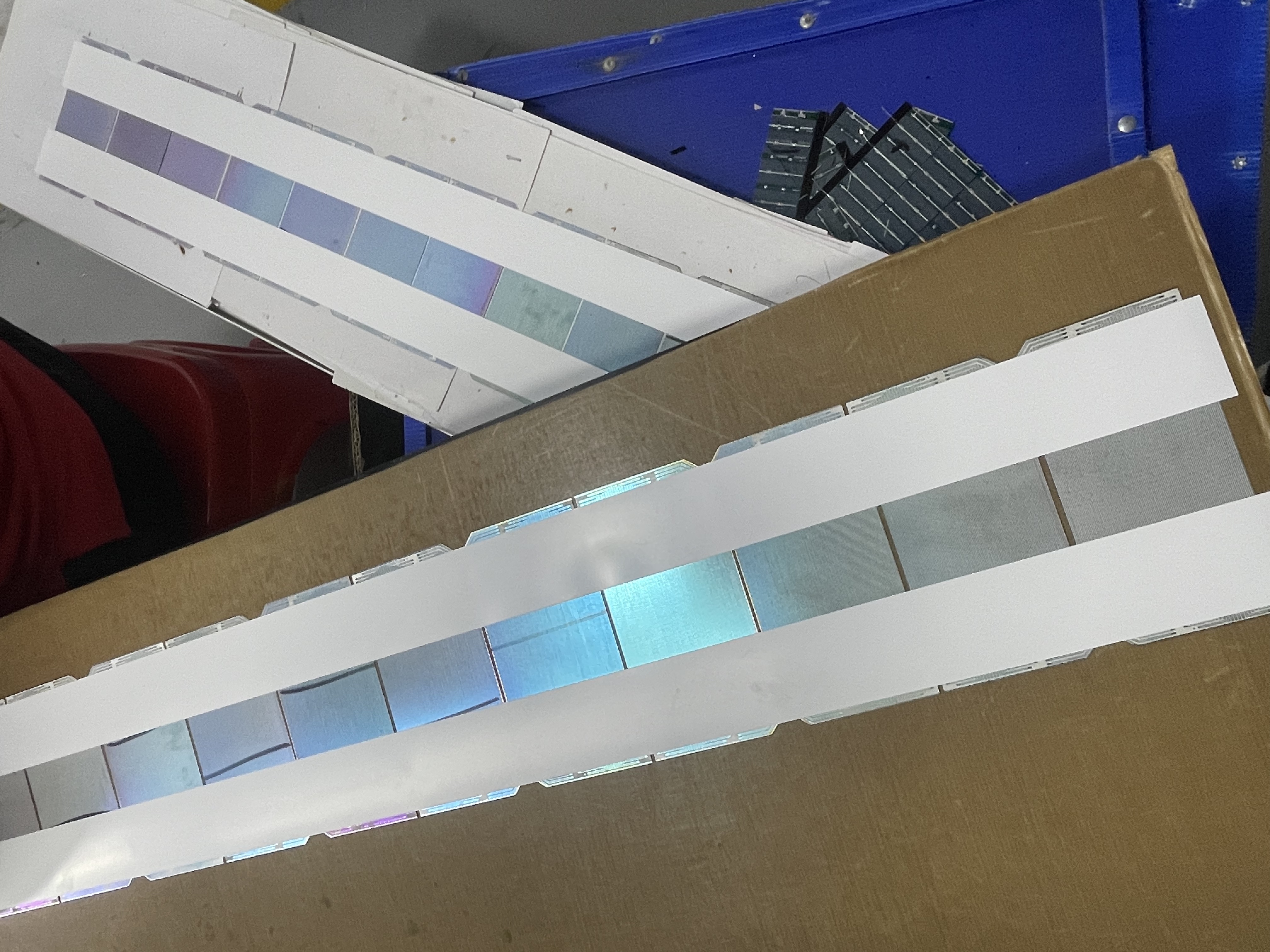
Incoming inspection is where a technology decision becomes a physical fact, and four checks catch nearly every substitution or handling defect.
I spend part of every week at our incoming inspection station, and the first thing I look at is not the datasheet but the EL image: a genuine TOPCon batch shows even finger printing and no dark edge banding, and any cell with a visible crack or dark corner leaves the tray immediately. The second check is the flash-test curve, because a PERC cell and a TOPCon cell of the same wattage produce different curve shapes near the maximum power point. The third is solder pull strength on a sample string after lamination, and the fourth is a 96-hour IEC 62804 PID sample pull at 85°C/85% RH, which is where a cheap EVA instead of POE shows itself.
Certification is the floor, not the differentiator. Every module we ship carries IEC 61215 for design qualification and IEC 61730 for safety, and the IEC and UL certification guide explains which certificate actually applies to which market, while our PID explainer covers the test conditions to demand in writing. Send your project parameters through request a quote or browse the product catalogue — we will tell you which cell platform we would actually put on the pallet, including when it is not TOPCon.
Frequently Asked Questions
Is TOPCon or HJT better in 2026?
Neither is universally better. HJT has the higher efficiency ceiling, 22.5–23.5% at module level, and the better temperature coefficient at around -0.24 to -0.26 %/°C, so it wins in hot, land-constrained projects. TOPCon delivers 22.0–23.2% modules at roughly $0.02–0.035/W less, with far wider supply and shorter lead times, which is why it dominates volume. Choose HJT when yield per square metre justifies the premium.
Is PERC still worth buying in 2026?
Only for replacement stock, tenders that still specify it, or projects where area is unlimited and price is the sole constraint. The PERC-to-TOPCon price gap has narrowed to roughly $0.005–0.015/W, while PERC modules are 1.5–2 efficiency points lower, so you need 7–10% more modules and more racking for the same capacity. On any area-limited roof or site, PERC now costs more overall.
How do I verify I am really receiving TOPCon cells?
Ask for three things before booking: electroluminescence images of the actual production batch, cell-level datasheets naming wafer format and paste pattern, and a flash-test report per pallet at ±3% tolerance. A PERC module and a TOPCon module look identical on a pallet, so the check has to be documentary and electrical, not visual. Independent lab testing on a sample is the final backstop.
Does HJT really produce more energy in hot climates?
It produces more per rated watt, mainly because its temperature coefficient is about -0.24 to -0.26 %/°C against -0.29 to -0.32 for TOPCon and -0.34 to -0.37 for PERC. At 65°C cell temperature that is roughly a 2–4% yield advantage over TOPCon. Whether it repays a $0.02–0.035/W premium depends on irradiance, tariff and how area-constrained the site is.
Which cell technology should an importer choose for distribution stock?
For distributor stock, TOPCon is usually the right answer: 22.0–23.2% module efficiency, 0/+5 W sorting available, no indium or low-temperature paste exposure, and multiple factories able to ship the same format on 4–8 week lead times. PERC only makes sense if your installers still work with legacy string designs; HJT is hard to stock because demand is project-specific and price moves with indium.