Power Tolerance in Bulk Solar Panel Orders: Why 0/+5 W Matters
A 0/+5 W power tolerance guarantees a 550 W panel measures 550–555 W at STC. A -3% band can cost 30 kW on a 1 MW order — here's how to specify it.
A 0/+5 W power tolerance means every module flash-tests at or above its nameplate rating and no more than 5 W above it, so a “550 W” panel must measure 550–555 W at STC. A negative band such as -3 % contractually allows that same module to ship at 533 W. On a 1 MW order of 550 W panels — 1,818 pieces — that gap is roughly 30 kW of capacity you paid for and never received.
What does 0/+5 W power tolerance mean on a solar panel?
It is a guarantee that the bottom of the band sits exactly at the nameplate number and the top no more than 5 W above it, measured on a calibrated flash tester at standard test conditions.
STC means 1,000 W/m² irradiance, 25 °C cell temperature and the AM1.5G spectrum, and the procedure itself sits inside IEC 61215 and IEC 60904-3. A 5 W window is 0.9 % of a 550 W nameplate and 1.1 % of a 440 W nameplate — tight enough that the module you receive will not be the weakest link in a string by more than a rounding error.
Datasheets in the market print four different things: 0/+5 W, 0/+3 %, -3 %/+3 % and -5 W/+5 W. Read the first number as the promise and the second as the disclaimer. A ±3 % datasheet is barely a specification: it is a range wide enough to cover a production flasher’s absolute uncertainty, which is typically ±3 % even when the tester is traceable to a reference cell under IEC 60904-2. Repeatability on the same tester is usually better than ±1 %, and repeatability is what sorting actually depends on — which is why a factory can honestly promise 0/+5 W while running a tester with ±3 % absolute accuracy.
Is negative power tolerance bad for solar modules?
Yes — a negative tolerance transfers process risk from the factory’s balance sheet to yours, and you cannot recover it once the container has sailed.
Run the arithmetic. A -3 %/+3 % band on a 550 W label is 533.5 W to 566.5 W: a 33 W spread across modules that carry the same label and usually the same price. If a shipment lands at the bottom of that band you receive 970 kW of nameplate on a 1 MW order, and the array generates about 3 % less energy every year for 25 years at the same racking, cabling and labour cost. The performance warranty will not save you, because it guarantees a percentage of the labelled watts — a 533 W module that is 3 % down is still “100 % of nameplate” on paper.
Negative bands are a legacy of the polycrystalline era, when cell efficiency spread inside a batch was wide enough that ±3 % was genuinely hard to avoid. That excuse is gone. TOPCon and mono PERC cells are now sorted at the cell tester in 0.05–0.1 A or 0.1 W steps before stringing, so module-level spread is dominated by the flasher, not the cells. When a supplier still prints -3 %, it usually means unsorted or downgrade cells, re-labelled stock, or a deliberate decision to keep the top of the band for a better-paying buyer. Our breakdown of flash tests versus rated output shows how those three cases look on a test report.
Why do suppliers sort solar panels by power bin?
Because a series string runs at the current of its lowest-current module, so sorting by current bin is the only practical way to stop one module taxing the other nineteen.
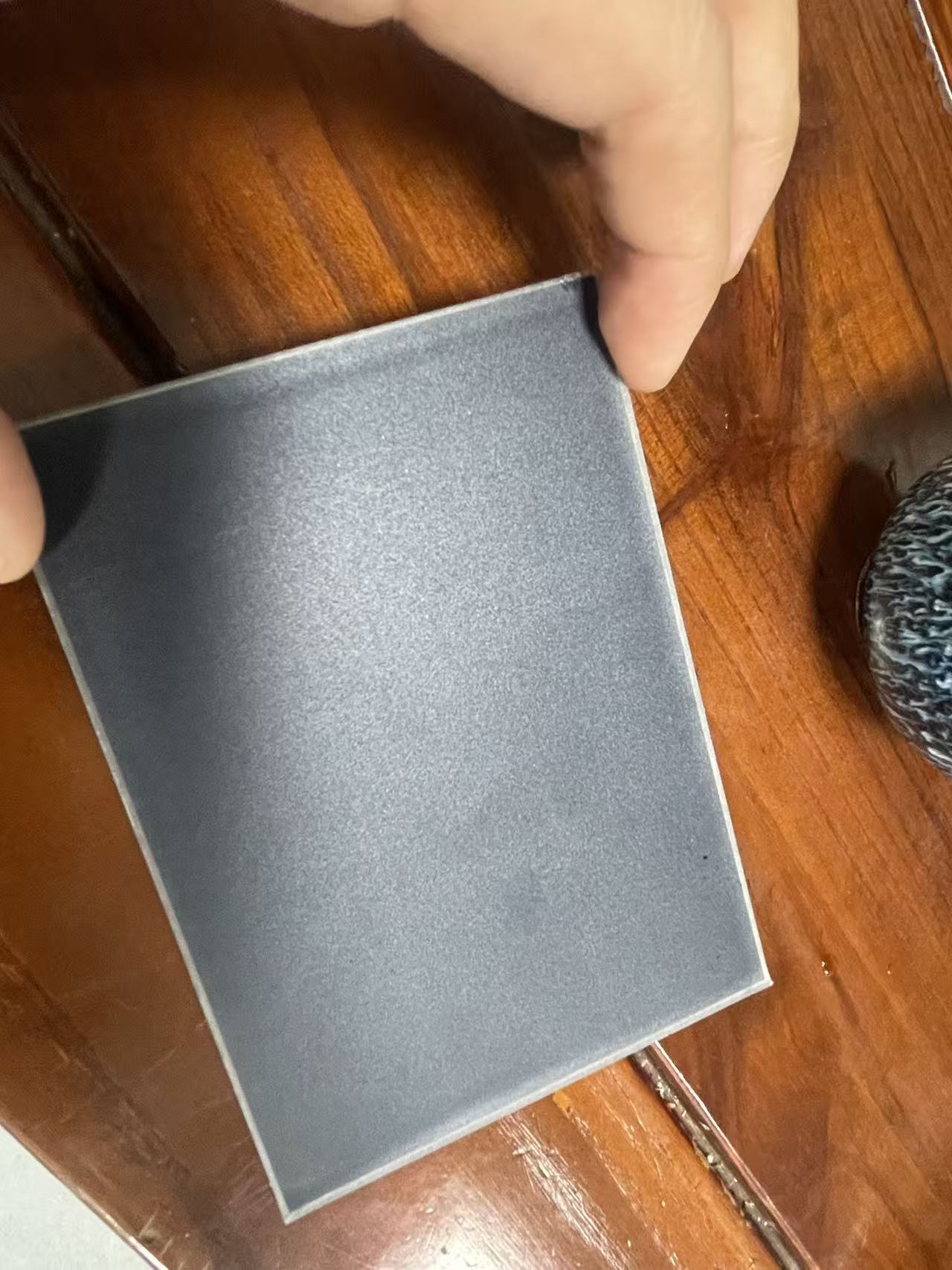
What the flash tester actually records
A production flasher fires a pulse of roughly 10 ms and sweeps the IV curve, recording Isc, Voc, Impp, Vmpp, Pmax and fill factor for every module that comes off the line.
The sorter then assigns a bin — commonly 5 W wide for power bins, or 0.05–0.1 A wide for current bins on tighter lines — and prints that code on the module label, the carton and the pallet. The bin code is what makes a matched string possible on site; without it the installer is guessing, and guessing on a 20-module string costs yield you never see on a datasheet.
Where binning breaks down in bulk orders
Binning only helps if the bin survives logistics, and on bulk orders it frequently does not.
I walk our flash-test line regularly, and the step that matters most is the one nobody photographs: the sorter writing the bin code onto the label at the same moment the IV curve is measured. If those two outputs are not tied together electronically, a mixed pallet is one tired shift away. In incoming inspection with a client, the first check is whether every module on a pallet carries the same code and whether the serials match the flash-report CSV. Two codes on one pallet is common — usually because the factory ran short of a bin at the end of a run and topped the last pallets up from the bin below. Not fraud, but your yield.
| Sorting practice at the factory | What you actually receive | String-mismatch risk | Fits |
|---|---|---|---|
| No binning, tolerance only (-3 %/+3 %) | Random spread across a 33 W band on 550 W labels | High — up to ~1 % string loss if mixed in one string | Single-panel off-grid kits only |
| 5 W power bins, one bin per pallet | Matched pallets, bin code on label and carton | Low if pallets are kept together on site | Rooftop and small commercial strings |
| 0.05 A current bins, serial-linked flash report | Near-identical Imp, traceable per serial number | Negligible | Utility-scale and EPC tender work |
| Binned in the factory but mixed at loading | Cheapest $/W quote, mixed pallets on arrival | Up to ~1 % of array output, permanent | Nothing — reject or re-sort on site |
Mixing bins in one string: the real watts you lose
One module one bin lower drags the whole string down to its current, and the penalty is roughly 0.8–1.0 % of string output for that single bin step — permanently, because bypass diodes do not switch on for mismatch.
Take a 20-module string of 550 W-class TOPCon modules. A unit in the 555 W bin typically sits near Imp 13.12 A at Vmp 42.3 V; a unit in the 550 W bin sits near Imp 13.00 A. Wire nineteen 555 W modules in series with one 550 W module and the string current is pinned at 13.00 A. Every 555 W module now behaves like a 550 W module, so the loss is 19 × 5 W ≈ 95 W, or 0.86 % of the string’s 11,095 W nameplate.
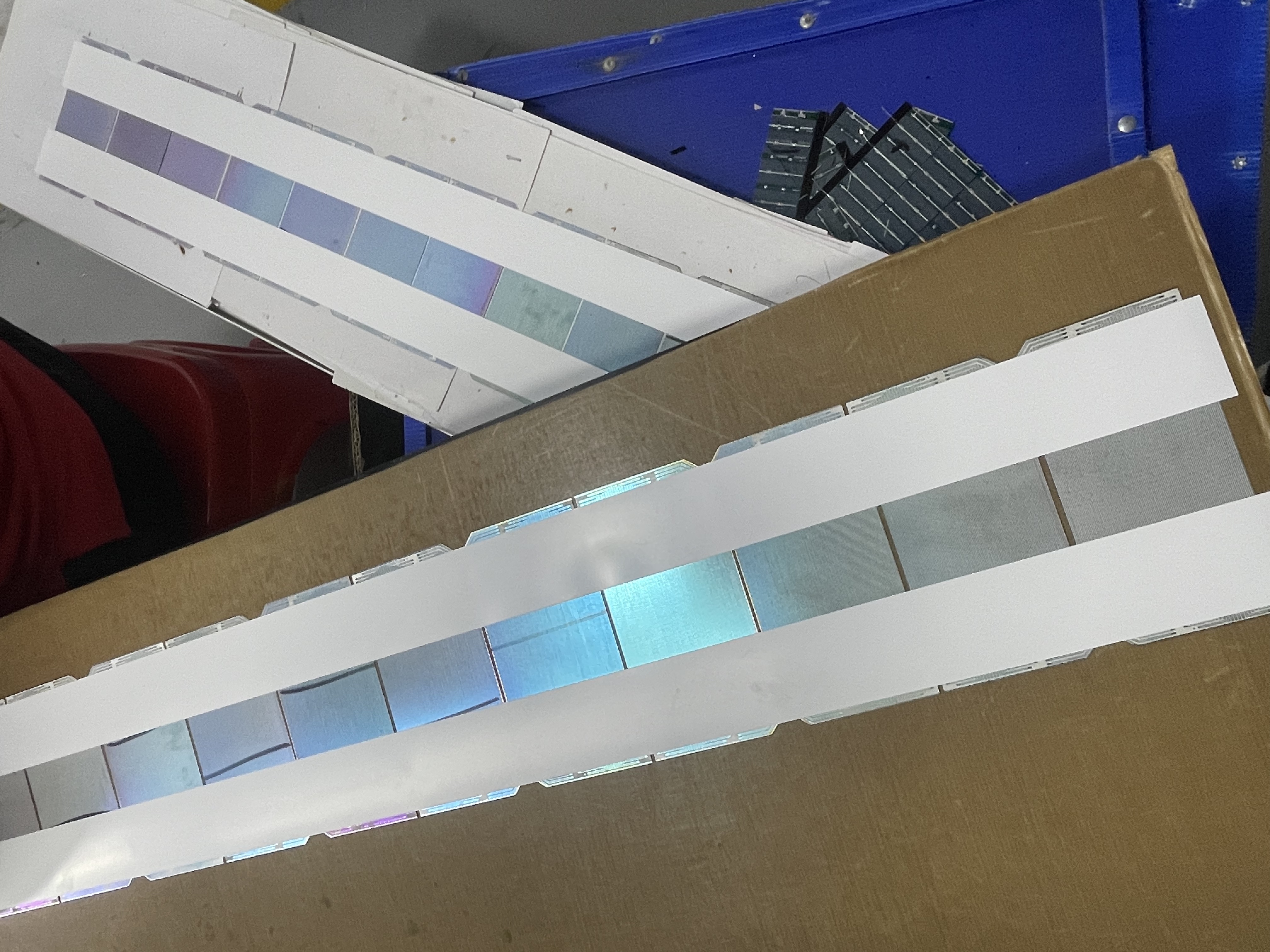
Scale that up: 0.86 % of a 1 MW array is 8.6 kW, which at a site yield of 1,500–1,700 kWh/kWp is roughly 13–15 MWh a year, every year, for a mismatch the supplier could have avoided at zero cost. Voltage mismatch is a smaller problem — an MPPT tracker sweeps the whole string and recovers most of it, typically a few tenths of a percent — but current mismatch is permanent and invisible on a datasheet.
The practical rule: if you must accept mixed bins, keep them on separate strings and separate MPPT inputs, never inside one string. On a 1,500 V utility array with 28-module strings, one mismatched module taxes twenty-seven others, so the leverage is worse than on a rooftop.
Tolerance vs total delivered watts in a 1 MW order
On a megawatt order the tolerance band is not a rounding error: the gap between 0/+5 W and -3 % is roughly 30 kW of capacity you have already paid for.
| Datasheet tolerance | Worst-case watts on a 550 W label | Delivered range per module | Shortfall across 1,818 modules |
|---|---|---|---|
| 0/+5 W | 550 W | 550–555 W | 0 W (upside to +9 kW) |
| 0/+3 % | 550 W | 550–566.5 W | 0 W |
| -5 W/+5 W | 545 W | 545–555 W | Up to 9 kW |
| -3 %/+3 % | 533.5 W | 533.5–566.5 W | Up to 30 kW |
| -5 %/+5 % (downgrade stock) | 522.5 W | 522.5–577.5 W | Up to 50 kW |
1,818 pieces of 550 W TOPCon is roughly three 40 ft HC containers, so the shortfall arrives as one container you effectively paid for and did not get — our container loading guide covers the packing maths. In energy terms, 30 kW at 1,500–1,700 kWh/kWp is 45–51 MWh a year; at a $0.09–0.12/kWh tariff that is $4,000–6,100 of annual revenue from capacity that never existed.
This is also why the cheapest $/W quote is usually the one with the widest band. Compare quotes on $/W at guaranteed minimum watts, not at nameplate; the 2026 price-per-watt breakdown shows how much of a low quote is simply a tolerance decision rather than a cost advantage.
What should you write into the purchase order?
Write the tolerance as an absolute wattage floor rather than a percentage, and attach a remedy to the flash-test data so the clause has teeth.
Tolerance and test clauses
- Pmax floor: “≥550 W at STC per IEC 61215 and IEC 60904-3, tolerance 0/+5 W; negative tolerance not accepted.” State the floor in watts, not only the band.
- Flash report per serial: a CSV issued with the shipping documents listing serial, Pmax, Impp, Vmpp, Voc, Isc and fill factor for every module.
- Tester calibration: certificate traceable to a reference cell under IEC 60904-2, issued within 12 months, plus repeatability better than ±1 %.
- Certificates and EL: IEC 61215 and IEC 61730 for the exact model, UL 1703 / UL 61730 for US-bound shipments, and electroluminescence images for the sampled modules.
- Acceptance sampling: three modules per container flash-tested at a third-party lab; any module below the floor triggers a full re-test at the supplier’s cost.
Commercial clauses
- One bin per pallet, code printed on label and carton; mixed pallets rejected at destination.
- No substitution to a lower bin without written approval, plus a credit at contract $/W for any wattage shortfall.
- Degradation and temperature fixed in the same annex — typically -0.29 to -0.35 %/°C for TOPCon and 0.4–0.55 %/yr — because a module that starts low also degrades from a lower base. Our temperature coefficient guide explains the interaction for hot-climate sites.
- PID and humidity covered by IEC 62804 if the project is coastal or humid, with IEC 61701 salt mist and IEC 62716 ammonia testing where the site demands it.
Before any of that, audit the line: watch a module go through the flasher, read the calibration date, and compare the printed bin code with the CSV. Our factory audit checklist and the field test guide cover the checks that catch a tolerance problem before the deposit leaves. To see the flash-report format and bin guarantees we ship as standard, send us your specification and we will quote against your wattage floor.
Frequently Asked Questions
Is a 0/+5 W power tolerance worth paying more for?
Usually yes, but quantify it first. On a 1 MW order a -3 % band can remove up to 30 kW of nameplate, worth roughly 45–51 MWh a year at a 1,500–1,700 kWh/kWp site. If the 0/+5 W premium is below the value of that lost generation over the first few years, it pays for itself. If it is higher, negotiate rather than walk away.
How can I verify power tolerance when the container arrives?
Pull three modules per container, record the serial numbers, and flash-test them at a third-party lab against STC. Compare measured Pmax with the label and with the factory flash-report CSV. Also check that every module on a pallet carries one bin code. A single module below the stated wattage floor justifies demanding a full re-test at the supplier's cost.
Can I mix different power bins in one solar array?
Only across separate strings or separate MPPT inputs, never inside one string. Series-connected modules run at the lowest current in the string, so one module a bin lower pulls every other module down by roughly 0.8–1.0 % of string output per bin step. Bypass diodes do not activate for ordinary mismatch, so the loss never recovers.
Why does the flash-test report show more watts than the label?
Because 0/+5 W is a positive-only band: the module is allowed to measure up to 5 W above nameplate, so a 550 W label with a 553 W flash result is compliant. Positive tolerance costs you nothing, but ask for the distribution of Pmax across the shipment, not the average, because a tight cluster near the floor still means the process is running at its limit.
Is a negative power tolerance a sign of B-grade cells?
Not always, but often enough to ask. Downgrade or unsorted cells are frequently sold under a -3 %/+3 % or -5 %/+5 % band, because the supplier cannot guarantee the floor. Tier-one lines running sorted TOPCon or mono PERC cells hold 0/+5 W without difficulty today. If the datasheet is negative, request the cell supplier, sorting resolution and a serial-level flash report.