Solar Panel Price per Watt in 2026: What Actually Moves the Number
TOPCon panels run $0.088–0.115/W FOB China in 2026. The real cost breakdown per watt — cells, glass, frame, freight — and how to read a quote.
For 2026, mainstream TOPCon modules shipped from China sit at roughly $0.088–0.115 per watt FOB, mono PERC clears at $0.080–0.105/W, and flexible ETFE panels run $0.35–0.60/W. That figure covers cells, glass, frame, encapsulant, junction box, packaging and factory margin — nothing after the container leaves port. Two suppliers quoting $0.095/W can end up $0.02/W apart once you normalise flash-test tolerance (±3%) and power tolerance (0/+5 W).
Solar Panel Price per Watt in 2026: What the FOB Number Really Contains
A price per watt is the module's FOB unit price divided by its flash-tested wattage, so a 590 W TOPCon module at $56.05 FOB is $0.0950/W.
The denominator has to be the value on that module's own flash-test label — measured at 1000 W/m², 25 °C cell temperature and AM1.5G spectrum. IEC 61215 and IEC 61730 require the nameplate to sit inside the declared tolerance band, and most Chinese lines bin to 0/+5 W: a "590 W" module never leaves below 590 W, but rarely exceeds 595 W. Quote from a datasheet peak and you are comparing a marketing number against a production average.
FOB, CIF and DDP Are Three Different Numbers
A 40HC carries roughly 620–700 pieces of 182 mm 72-cell module, about 380–450 kWp depending on wattage and packing (the full maths is in our container loading guide). At $2,500–4,500 ocean freight per container that is $0.006–0.012/W. Add 5–15% import duty plus inland haulage in many African and Southeast Asian markets, and a $0.095/W FOB line becomes $0.11–0.13/W DDP. When a competitor's number looks 20% cheaper, check which of the three it is.
Why the Watts in the Denominator Decide the Deal
A 620 W module at $58.30 is $0.0940/W; a 590 W module at $56.05 is $0.0950/W. On a 20 MW order that 1% gap is roughly $20,000 — decided by arithmetic nobody checks. Module-level comparison also collapses when format changes: 210 mm-format modules at 2382 mm need different clamp positions and rail spans, so the lowest $/W is not automatically the lowest cost per installed kWp. Normalise the 11 datasheet fields listed in our datasheet checklist before you compare.
Why Do Solar Panel Prices Change? Four Cost Blocks Set the Floor
Prices move because 55–65% of a module's cost is the cell, and cell price tracks polysilicon, silver paste and wafer utilisation — none of which a module assembler controls.
The other three blocks are materials (glass, aluminium, encapsulant, backsheet), conversion cost (electricity, labour, depreciation, yield loss) and logistics with FX. Each runs on a different clock. Polysilicon can move 20–30% in a quarter, glass follows float-line utilisation, aluminium tracks the LME, and the RMB/USD rate shifts the dollar price of all of it at once. That is why a 30-day-old quote is not a quote.
Cell, Glass, Frame and Labour: Where Each Dollar Sits
| Cost block | Share of FOB cost | What moves it |
|---|---|---|
| TOPCon cells, 182 mm | 55–65% | Polysilicon price, silver paste, wafer capacity utilisation, efficiency bin |
| Front glass | 7–9% | Float-line utilisation, 3.2 mm vs 2.0 mm tempered, AR coating |
| Aluminium frame | 5–7% | LME aluminium, profile depth, anodising thickness |
| Encapsulant and backsheet | 6–9% | POE vs EVA, double-glass vs backsheet, thickness |
| Junction box, cables, connectors | 2–3% | IP68 rating, bypass diode count, cable length, branded vs compatible connectors |
| Ribbon, busbar, flux, consumables | 2–3% | Busbar count, ribbon width, silver-coated copper price |
| Conversion: labour, power, depreciation, yield loss | 6–9% | Line automation level, cell-to-module loss, regional electricity tariff |
| Packaging and inland haulage to port | 1–2% | Carton design, corner protectors, pallet type, distance to port |
Those shares are typical for a 182 mm TOPCon module at 1 MW+ volume. A double-glass BOM shifts three to four points out of backsheet and into glass; a 2.0 + 2.0 mm glass BOM moves them again.
What I Check Before a Lot Ships
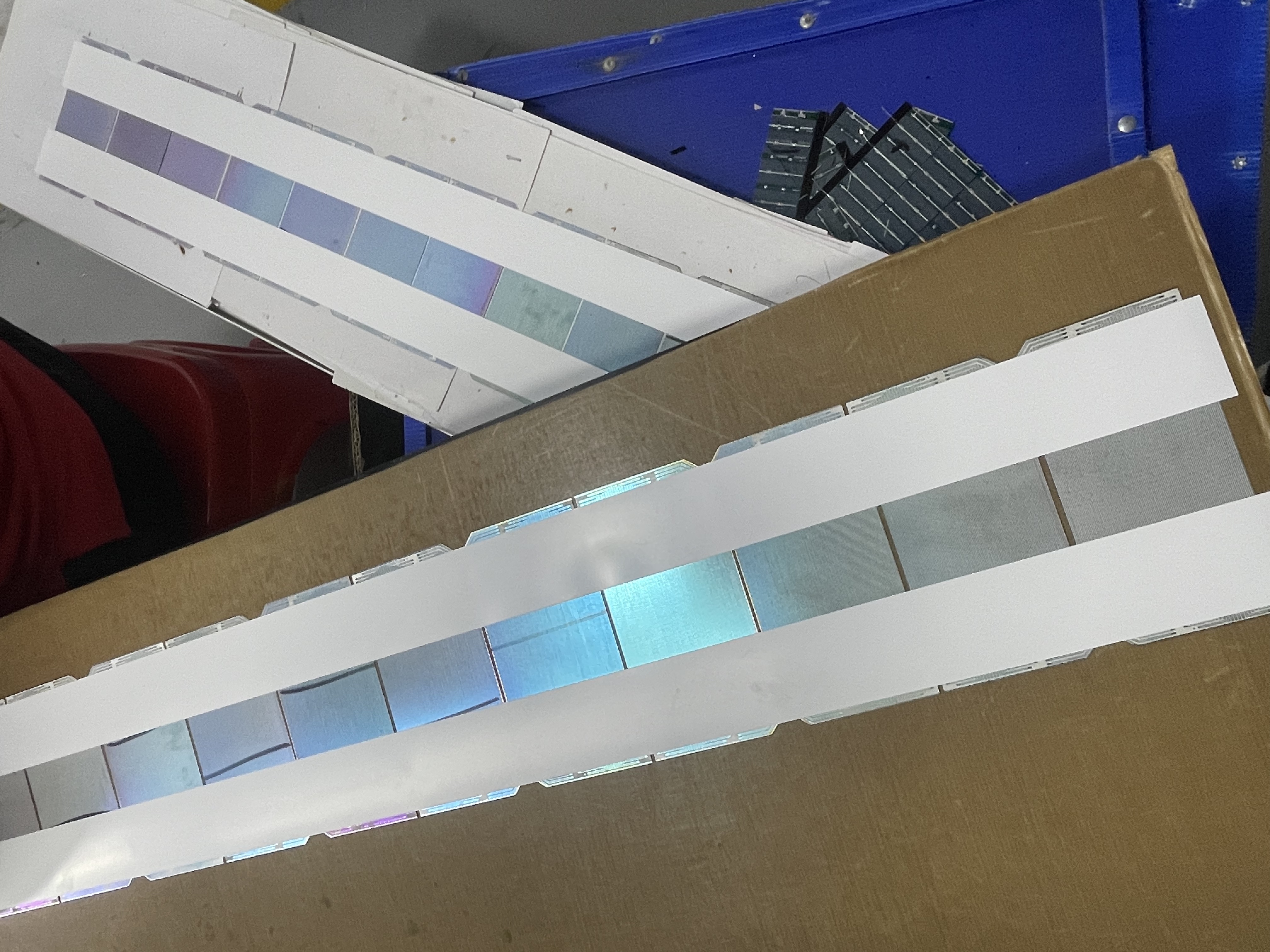
On our incoming bench I pull one carton per cell lot and electroluminescence-scan every module against the golden image — microcracks appear as dark branching lines long before they appear as watts lost. Any lot with visible EL drift is re-flashed and quarantined. We run IEC 62804 at 85 °C / 85% RH with −1000 V bias for 96 hours (the mechanism is explained in our PID guide), IEC 61701 salt mist for coastal destinations, and IEC 62716 ammonia where the end user runs livestock or fertiliser storage. Buyers rarely ask for salt mist until the rooftop is already 3 km from the sea.
TOPCon Module Price FOB China: What the Premium Over PERC Really Is
In 2026 TOPCon carries only a $0.003–0.010/W premium over PERC at the same format, and in 72-cell utility sizes it is often at parity because PERC capacity has shrunk into small-lot runs.
| Module type, 2026 | Typical wattage | FOB China USD/W | Where it fits |
|---|---|---|---|
| TOPCon 182 mm, 54-cell | 430–450 W | 0.100–0.130 | Residential rooftop, mixed pallet orders |
| TOPCon 182 mm, 72-cell | 580–595 W | 0.088–0.108 | Utility and C&I, highest volume |
| TOPCon 210 mm, 66-cell | 650–700 W | 0.085–0.105 | Ground-mount and tracker projects |
| Mono PERC 182 mm, 72-cell | 545–555 W | 0.080–0.105 | Budget tenders, replacement stock |
| Flexible ETFE laminated | 100–200 W | 0.35–0.60 | Marine, RV, curved and weight-limited roofs |
| Custom or OEM rigid, non-standard size | 5–150 W | 0.30–0.80 | Private label, IoT, specialty housings |
Treat these as typical ranges at container volume — the final number depends on BOM, destination certificate scope, payment terms and how tight cell supply is that quarter.
Two specs quietly matter more than the headline. TOPCon typically runs −0.29 to −0.35 %/°C against −0.34 to −0.37 %/°C for PERC, which on a 45 °C desert site converts to roughly 1.5–2.5% more annual energy from the same nameplate (see our temperature coefficient buying guide). First-year degradation is commonly 1% for TOPCon versus 2% for PERC, then 0.4%/yr versus 0.55%/yr. Compounded over 25 years that outweighs the per-watt premium — which is why the cheapest PERC lot is rarely the cheapest kWh.
Volume, Payment Terms and Seasonality: Three Levers Buyers Control
Order volume, payment structure and order timing move a per-watt price more than any negotiation, and together they are worth $0.005–0.020/W.
- Volume: a single 40HC (~380–450 kWp) sits at list price. Five to ten containers gets you a quarterly agreement; 1 MW+ on a rolling 12-month schedule earns priority cell allocation, which matters more than the discount when TOPCon cells are tight.
- Payment terms: 30% T/T deposit with 70% before shipment is the baseline. An LC at sight adds roughly 0.5–1.5% in bank charges and document handling; 60–90 day open account typically prices in a 1.5–3% risk premium.
- Seasonality: Q1 is soft — Chinese New Year stops lines for 2–3 weeks and European rooftop demand is dormant. Q2–Q3 is peak for Middle East and EU buyers, Q4 brings year-end shipment pushes. A Q1 order can save $0.002–0.005/W.
- Wattage standardisation: committing to one bin instead of splitting 580/590/600 W cuts sorting, packing and mixed-pallet cost, and makes warranty replacement far simpler five years later.
- Private label scope: printed frames, custom cartons and manuals add roughly $0.002–0.006/W at MOQ, and the MOQ rules are set out in our private-label guide.
Solar Panel Cost Breakdown per Watt: Reading a Quote Line by Line
A defensible per-watt quote states wattage basis, BOM, certificate scope, Incoterm and validity — miss any one and the number is not comparable.
- Wattage basis. Ask whether the price is against production-average flash test or datasheet peak, and request the bin distribution. A quote priced on 600 W that ships 585–595 W is a 2% increase in disguise.
- BOM line items. Cell supplier and cell type, glass thickness (3.2 mm vs 2.0 + 2.0 mm), frame profile and anodising, junction box IP rating, cable length and connector brand. Each item is worth $0.001–0.004/W on its own.
- Certificate scope. IEC 61215 and IEC 61730 are the floor for most markets, while UL 1703 still governs some North American channels. Confirm the certificate names the exact model and the factory that will build it, as explained in our certification guide.
- Incoterm and freight. Separate module price from ocean freight, insurance, duty and inland haulage so you can see which line is moving next quarter.
- Warranty arithmetic. 12–15 year product and 25–30 year performance are standard, but ask what the claim is denominated in — replacement module, pro-rata cash, or credit against a future order.
- Audit before the repeat order. The first container is a sample; the third is a relationship. Our factory audit checklist covers the nine documents to request.
Where a Good Per-Watt Quote Still Goes Wrong
Most price surprises come from substitution at shipment rather than from the quoted number itself. Watch for wattage re-binning (575 W shipped against a 590 W price with no credit), EVA where the BOM said POE, a 30 mm frame where the drawing said 35 mm, and "A-grade" language with no EL data behind it. Check price validity too: most Chinese factories hold a module quote for 7–15 days, and longer validity usually carries a currency or polysilicon clause. To compare three factories fairly, send the same BOM template and the same destination; our team will return a line-by-line breakdown against the product catalogue and confirm current cell allocation through contact. Everything above assumes IEC 61215 and IEC 61730 construction binned to 0/+5 W — if a supplier will not put that in writing, the per-watt number is not a real number.
Frequently Asked Questions
Is $0.09 per watt realistic for TOPCon panels from China in 2026?
Yes, at container volume. Mainstream 182 mm 72-cell and 210 mm 66-cell TOPCon modules price around $0.088–0.108/W FOB, and $0.09 is achievable on 1 MW+ orders paid by T/T. Below $0.085/W, check the BOM carefully — thinner glass, a smaller junction box or re-binned wattage usually explains the gap.
Why is the price per watt different from the price per panel?
Because panels come in different wattages. A 590 W module at $56.05 and a 620 W module at $58.30 look $2.25 apart per panel, but they are $0.0950/W and $0.0940/W respectively. Always divide by the flash-tested wattage before comparing, and never compare your supplier's production average against a competitor's datasheet peak.
Does a higher price per watt mean a better panel?
Not by itself. Above roughly $0.13/W in 2026 you are usually paying for small volume, non-standard dimensions or expedited production rather than better cells. Quality shows up in documentation: EL images per lot, IEC 61215 and IEC 61730 certificates naming the exact model, a 0/+5 W bin, and a defined PID and salt-mist test regime.
How much does ocean freight add to the per-watt price?
One 40HC holds about 380–450 kWp, and freight runs $2,500–4,500 per container depending on route and season, adding roughly $0.006–0.012/W. Add 5–15% import duty, port charges and inland haulage, and landed cost commonly sits 15–30% above the FOB number you were quoted.
How long is a solar panel price quote valid?
Most Chinese factories hold a module quote for 7–15 days, because cell and glass prices move weekly. Quotes offering 60 or 90 days validity usually carry a polysilicon or exchange-rate clause that adjusts the final invoice. For budget certainty, ask for a fixed-price quarterly agreement with a defined volume schedule instead of a long-validity spot quote.