PID in Humid Climates: How Buyers Screen Modules Before It Costs Them
PID can strip 5-30% of output in humid, high-voltage arrays. How IEC 62804 testing and BOM choices separate real PID resistance from datasheet claims.
Potential induced degradation (PID) is a voltage-driven leakage-current failure that can strip 5-30% of a module's output in humid, high-voltage arrays, and buyers screen it with IEC 62804-1: modules are held at 60 °C/85% RH (Method A) or 85 °C/85% RH (Method B) under -1000 V to -1500 V bias for 96 hours and must lose under 5% of pre-test flash power. A datasheet claim without that report is a coastal warranty claim in waiting.
What is potential induced degradation in solar panels?
PID is the electrochemical migration of ions — mostly sodium leached from glass and encapsulant — toward the cell, driven by the voltage difference between the cell string and the grounded frame.
In a 1500 V string, cells at the negative end sit 1500 V below earth. Moisture at the glass-encapsulant interface turns that voltage into a small but continuous leakage current, typically microamps to a few milliamps per module. Sodium ions ride it to the cell surface, where they either shunt the emitter (PID-s) or trap charge in the passivation stack (PID-p). PID-s appears as a falling fill factor and dark patches on an electroluminescence image; PID-p appears as a voltage shift that partly reverses overnight when the array sits at zero bias.
Field-visible damage usually starts at the negative end of the string and at the module edges nearest the frame, because that is where the electric field concentrates and where moisture enters first. Our full PID explainer covers mitigation and recovery; this article is about what a buyer should demand before the container ships.
Why humidity and voltage stress drive PID in coastal installations
Coastal sites fail faster because warm, humid, salt-laden air keeps insulation resistance low enough for ionic conduction to run most of the year, and 1500 V strings apply roughly 50% more driving force than 1000 V.
The leakage-current path
Three things must line up for PID: a conductive path, an ion source, and a sustained field. Humidity supplies the first two. Above roughly 60% average relative humidity, encapsulant moisture content stops being negligible and leakage current climbs steeply — it follows an Arrhenius relationship with temperature, which is exactly why IEC 62804 uses 60 °C and 85 °C chambers instead of ambient. A coastal array sitting at 30 °C and 80% RH through a wet season is not far off Method A conditions in its worst weeks.
Voltage sets the magnitude. Moving from 1000 V to 1500 V raises stress on the same BOM by half, which is why the 1500 V transition caught out p-type PERC product that had passed 1000 V PID testing comfortably. If you are buying for a hot, humid site, read cell temperature and voltage together — our temperature coefficient guide shows how those two numbers interact.
Salt mist, ammonia and the tests that run alongside
PID is not the only humid-climate test a buyer should see. IEC 61701 (salt mist corrosion) matters for coastal and island projects; IEC 62716 (ammonia corrosion) matters near livestock. Neither measures PID, but they stress the same interfaces — frame sealant, junction box potting, backsheet edges — so a module that passes one and fails the other tells you the BOM was optimised for a single failure mode. Our certification guide for importers lists which reports belong together.
What PID losses look like in coastal solar installations
In real coastal arrays, PID typically shows as 5-30% power loss spread unevenly across a string, with the modules nearest the negative terminal losing the most.
The pattern matters more than the average. Because loss is position-dependent, a 30-module string with three badly degraded modules can lose more than its arithmetic share: the degraded modules become current limiters under mismatch, and the inverter's MPPT settles on a lower operating point for the whole string. That is how buyers end up with 8% array-level loss from modules that flash-test only 4% below nominal. Thermal imaging and string-level I-V curve tracing are the practical diagnostics; a shunt-affected module runs cooler, not hotter, because it is converting less.
Recovery depends on the mechanism. PID-p recovers substantially when the array sits at zero or reverse bias overnight, which is why PID recovery boxes and virtual-ground inverters exist. PID-s is largely permanent. Plan a 25-year coastal asset around the permanent case, not the recoverable one.
How to test PID resistance on a solar module: IEC 62804 explained
IEC 62804-1 biases a full-size module at system voltage inside a humidity chamber for 96 hours, then compares pre- and post-test flash power; a pass means under 5% degradation plus a clean IEC 61730 insulation test afterwards.
| Parameter | IEC 62804-1 Method A | IEC 62804-1 Method B | Extended factory run (typical) |
|---|---|---|---|
| Chamber temperature | 60 °C, ±2 | 85 °C, ±2 | 85 °C, ±2 |
| Relative humidity | 85%, ±5 | 85%, ±5 | 85%, ±5 |
| Applied bias | System voltage, -1000 V or -1500 V | System voltage, same | Both polarities |
| Duration | 96 h | 96 h | 1000 h |
| Pass criterion | Under 5% power loss vs pre-test flash | Under 5% power loss | Under 5% plus wet leakage current check |
| What it screens | Humid field condition at realistic temperature | Harsher acceleration on the encapsulant | Margin, not just pass or fail |
Two details buyers miss. The test is polarity-specific: a report run at negative bias says nothing about positive-bias behaviour, which matters for bifacial and some n-type architectures. And 96 hours is a screening test, not a service-life prediction — a module passing at 3.8% loss has far less margin than one passing at 0.8%, yet both carry the same certificate line.
What the IEC 62804 test does not prove
- It does not model 25 years of combined humidity, thermal cycling and salt deposition; IEC 61215 sequence testing covers thermal and mechanical stress but touches PID only indirectly.
- It does not tell you which module in the string degrades — the negative-end module sees nearly full bias, the positive end almost none.
- It does not validate your grounding scheme, inverter topology or PID recovery hardware.
- It does not survive BOM substitution: if the encapsulant grade or cell supplier changes, the report is stale.
BOM choices that raise PID margin
The three BOM decisions that move PID margin most are encapsulant chemistry, cell architecture and the backsheet-glass combination; the frame matters only where it changes the grounding path.
| BOM route | Typical IEC 62804 result | Cost vs baseline | Specify when |
|---|---|---|---|
| EVA + polymer backsheet + p-type PERC | Passes at 3-5% loss | Baseline | Inland, 1000 V, average RH under 60% |
| EPE co-extruded + non-permeable backsheet | Passes at 1-3% loss | +1-3% | Coastal, 1500 V, poorly ventilated rooftop |
| Full POE + glass-glass | Passes under 1% loss | +4-8% | Floating, tropical, 1500 V bifacial |
| PID-resistant cells with resistive emitter | Improves margin without encapsulant change | +1-2% | When an existing BOM must be kept |
| System side: negative grounding or recovery device | No module change | +0.5-2% of BOS | Retrofitting arrays already showing loss |
Encapsulant: EVA vs EPE vs POE
Standard EVA is cheapest and most hygroscopic — it absorbs moisture and, under heat and UV, hydrolyses to release acetic acid, which both accelerates PID and corrodes grid fingers. Co-extruded EPE puts a polyolefin core in the moisture path and typically adds 1-3% to module cost depending on volume. Full POE has the highest volume resistivity and the lowest moisture vapour transmission rate, and is the default for 1500 V coastal projects and glass-glass bifacial modules.
Cells, glass and backsheet
PID-resistant cells use a resistive emitter and a tuned silicon nitride passivation layer. Many n-type TOPCon cells are more PID-tolerant than p-type PERC but not immune — the difference is BOM-dependent rather than categorical, and our TOPCon vs HJT vs PERC comparison lays out the trade-offs. Low-alkali or sodium-free glass removes much of the ion source. A non-permeable or glass backsheet closes the moisture inlet that edge-seal degradation opens first.
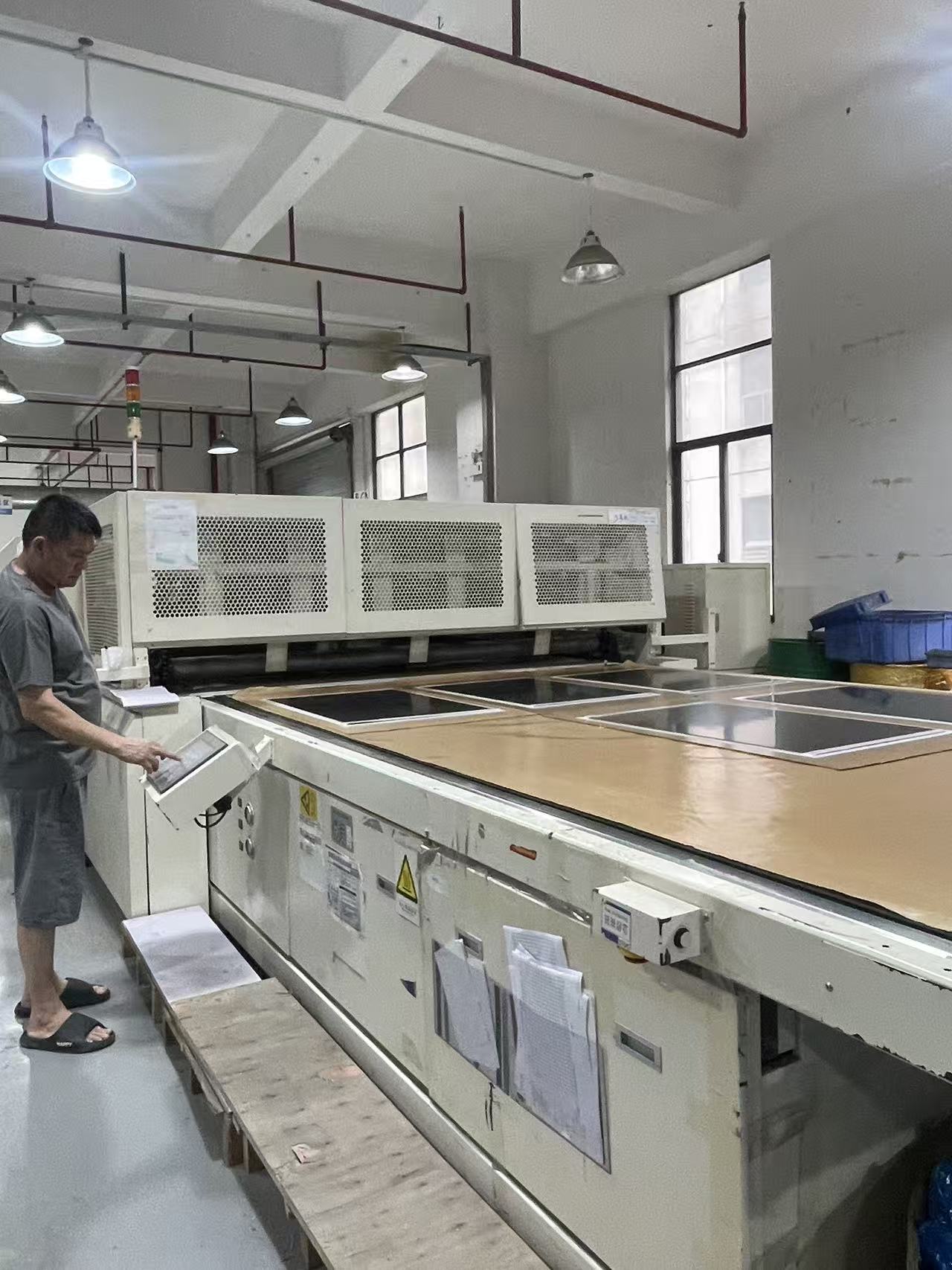
In our incoming inspection bay I open cell boxes from every supplier lot and run electroluminescence before anything reaches the stringer, because a cell with a latent emitter defect will fail PID long before an EVA-versus-POE decision shows up in the data. We laminate control modules with the production encapsulant and hold them at 85 °C/85% RH under -1500 V for 96 hours, logging wet leakage current before and after alongside the flash-test delta. The spread between two lots from the same supplier is usually wider than the spread between our TOPCon and PERC lines — which is the argument for lot-level IEC 62804 data instead of one certificate. Once you have that data, the seven factory tests for verifying real TOPCon cells tell you whether the cells you bought are the cells in the report.
Screening questions for your supplier
Ask for the IEC 62804 report with chamber temperature, bias voltage and per-module before-and-after flash data rather than a compliance statement — that single request filters out most trading companies within a day.
- Which IEC 62804-1 method was run, at what bias and which polarity, and can you send the per-module before-and-after flash table?
- What is the exact encapsulant grade and supplier (EVA, EPE or POE), and is that the material in the production BOM for our order?
- What is the worst-case power loss in your last ten PID runs, not the pass count?
- Has the BOM changed since the certificate was issued, and will you confirm in writing that it will not change for our shipment?
- Do you test both polarities, and at 1500 V if we are building a 1500 V array?
- Can we witness the pre- and post-test flash and EL in your lab, or appoint a third party to do it?
Run the arithmetic before you accept a cheap BOM. On a 1 MW coastal project using 550 W modules — roughly 1,800 pieces — a 3% average PID loss over ten years at 1,500 kWh/kWp/year and $0.10/kWh is about $45,000 of lost revenue, an order of magnitude more than the 1-3% BOM premium that would have prevented it. The exact ratio depends on your tariff, yield and BOM, but it rarely flips the other way. Send the site humidity profile, system voltage and string layout through our quote request form and we will spec encapsulant and cell type against it; the product catalogue lists standard IEC 62804 data per series.
Frequently Asked Questions
What counts as a good IEC 62804 PID test result?
Under 5% power loss is the pass line, but treat it as a floor, not a target. Ask for per-module numbers: a module that loses 0.8% at -1500 V has real margin, while one that loses 4.8% is inside spec and still a risk on a 25-year coastal asset. Anything above 3% deserves a BOM discussion before you book.
Do TOPCon panels suffer from PID?
Less than p-type PERC on most bills of materials, but not never. N-type TOPCon cells avoid much of the classic emitter shunting that hits PERC, yet positive-bias PID and moisture-driven corrosion still occur under high humidity at 1500 V. Test data matters more than the cell label, so demand IEC 62804 results for the exact BOM you are buying.
Can PID-degraded solar modules recover?
Partly, and only for one mechanism. Polarization-type PID recovers largely overnight when the array sits at zero or reverse bias, which is why recovery devices and virtual-ground inverters work. Shunt-type PID is largely permanent and shows as a fill-factor loss that never comes back. Model your 25-year coastal project on the permanent case.
Is 1500 V worse than 1000 V for PID?
Yes, roughly 50% more driving force at the same humidity and temperature, because PID scales with the voltage between the cell string and the grounded frame. Many modules certified at 1000 V have never been retested at 1500 V. If you are building a 1500 V array, specify a report run at 1500 V against the production BOM.
How much does a PID-resistant BOM add to module price?
Typically 1-3% for EPE encapsulant with a non-permeable backsheet, and 4-8% for full POE with glass-glass construction, depending on volume, cell type and order size. On a 1 MW coastal project, 3% average PID loss over ten years usually costs more than the whole BOM premium, though the exact ratio depends on tariff and yield.