I Ordered Custom Solar Panels for My RV Roof — Here Is What I Wish I Knew First
Step-by-step guide to ordering custom-size solar panels for RV rooftops from China. Real specs, real mistakes, real solutions from a Shenzhen solar supplier.
The Problem Nobody Talks About
You measure your RV roof. You find a perfect 47-inch wide space. You search for solar panels and discover that standard panels are 40 inches or 66 inches — nothing fits. You either waste space or start cutting wiring to make undersized panels work.
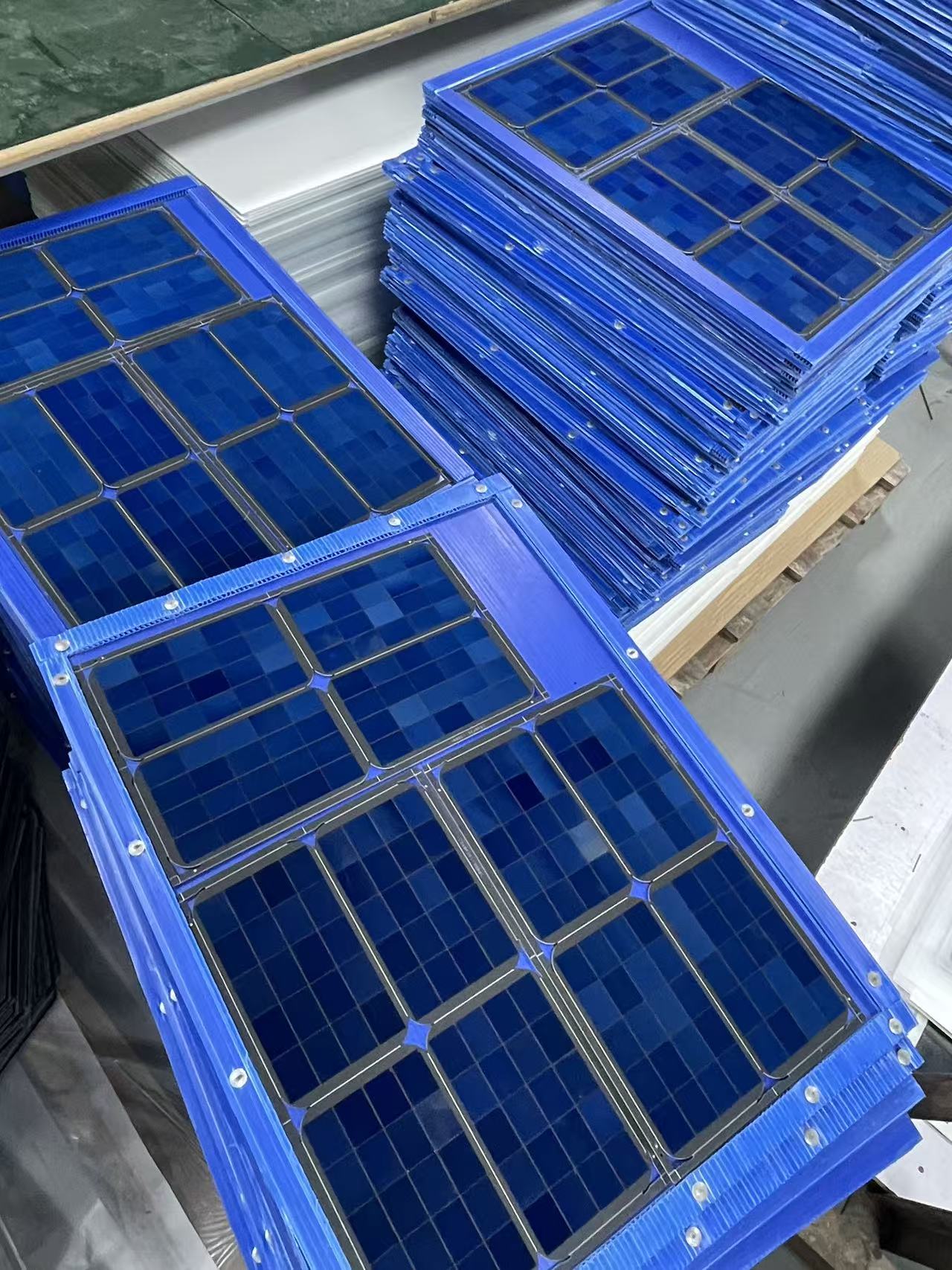
This is the most common frustration we hear from RV owners trying to go solar. Standard panel sizing is designed for rooftop residential installs, not the irregular geometry of a vehicle roof with vents, AC units and skylights eating into your usable area.
Step 1: Measure Correctly (Most People Get This Wrong)
Do not measure your roof and order panels to that exact size. You need clearance for:
- Frame overlap: panels need 5–10mm gap on each side for mounting brackets
- Thermal expansion: panels expand slightly in heat — allow 3–5mm
- Cable routing: you need a path for the junction box cables without sharp bends
The rule we give every RV buyer: subtract 30mm from your measured width and 20mm from your measured length. That is your panel order dimension.
Step 2: Cell Efficiency Matters More Than Wattage
A common mistake: ordering the highest wattage panel that fits the space. But wattage is just efficiency × area. If you have a fixed roof area, what you actually want is the highest efficiency cells in that area.
For RV applications, we recommend:
- TOPCon N-type cells: 22–23% efficiency, best performance in partial shade — common when trees or buildings partially block your roof
- Avoid older PERC panels for RV use: efficiency drops significantly under partial shading, which is unavoidable on a moving vehicle
Step 3: What to Tell Your Chinese Supplier
When requesting a custom panel quote, provide:
- Exact dimensions in mm (length × width × thickness)
- Target wattage or cell type preference
- Mounting type: framed aluminum or frameless
- Junction box position: short side or long side
- Cable length and connector type (MC4 is universal)
- Certification needed: UL (USA), CE (Europe), IEC (international)
- Quantity and delivery port
Real Example: 385W Panel for a 47-Inch Roof
| Specification | Figure From This Build | What It Means for an RV Roof |
|---|---|---|
| Usable roof space | 1,200mm × 600mm | Class C motorhome area left after vents, AC units and skylights |
| Order dimension rule | Subtract 30mm from width and 20mm from length | Leaves clearance for frame overlap, thermal expansion and cable routing |
| Custom panel size | 1,180mm × 580mm | Fits the measured space instead of wasting it or forcing an undersized standard panel |
| Panel output | 385W | Slightly below the 400W target because the reduced area allows fewer cells |
| Cell efficiency | 22.1% | Maximizes output inside a fixed footprint where wattage alone cannot |
| Degradation after 18 months | 1.1% at temperatures regularly exceeding 45°C | Well within the warranty specification of less than 2% per year |
A client in Arizona came to us needing panels for a 1,200mm × 600mm usable roof space on a Class C motorhome. Standard panels were either too wide or too short.
We sourced a custom 1,180mm × 580mm monocrystalline TOPCon panel producing 385W — slightly less than the 400W target due to the reduced area, but with 22.1% cell efficiency to maximize output in that footprint.
After 18 months of desert use (temperatures regularly exceeding 45°C), output degradation measured at 1.1% — well within the warranty specification of less than 2% per year. He now orders 120 units per quarter for his RV dealership's solar retrofit program.
The One Question That Separates Good Suppliers from Bad Ones
Ask any potential supplier: "What is the actual cell efficiency, not the panel efficiency?"
Panel efficiency includes the frame area which produces zero power. Cell efficiency tells you how good the photovoltaic material actually is. Any legitimate manufacturer can provide this from their cell test certificates. If a supplier cannot or will not provide cell efficiency data, walk away.
Lock the Custom Spec Before Production
A custom order should be confirmed from a controlled drawing, not a chat message. Ask the supplier to issue a dimensioned drawing that shows your measured roof space, the clearance subtraction you used, and the final panel order dimension. Approve it in writing before production begins.
Use that approved drawing to fix the details that cannot change after lamination: frame type, junction box position, cable exit and connector type. If the junction box lands over a vent, AC unit, skylight or cable route, move it on the drawing first.
- Check the panel order dimension against your own measurement, using the same clearance rule.
- Mark the junction box on the drawing and confirm it clears roof obstructions and the cable path.
- State framed aluminum or frameless on the drawing, not only in email text.
- Specify cable length and MC4 connector type on the drawing.
- Require the drawing to show the cell type and cell efficiency you are paying for.
- Keep the approved drawing revision as the reference for inspection and warranty records.
Audit the Paperwork and Plan the Roof Interface
A certificate for a standard panel model does not automatically cover a custom size. Ask whether the UL, CE or IEC certification you need applies to the custom panel as ordered, and request the document that shows the covered model or size range before you pay a deposit.
Compare the cell efficiency in the quotation with the value on the cell test certificate. Panel efficiency includes frame area; cell efficiency tells you whether the photovoltaic material is actually better. If the documents disagree, ask for a corrected quotation and a written explanation.
Before the panels arrive, lay out brackets, cable entries and service access on the empty roof. Decide how you will reach the junction box for inspection or replacement without removing the panel, and keep the thermal expansion gap from your measurement rule.
- Request certificate scope for the exact custom model or size range, not a generic brochure page.
- Confirm which UL, CE or IEC requirement applies to your destination and is listed on the order.
- Request cell test certificates that state cell efficiency for the quoted cell type.
- Dry-fit a cardboard template made to the approved panel order dimension before drilling.
- Route cables with gentle bends, secure them against vibration, and leave every MC4 connector accessible.
Related reading
- Flexible Solar Panel Delamination: Causes, Prevention & What the Warranty Really Covers
- Off-Grid Solar Panel System Sizing for a Home or Cabin
- I Bought Cheap Solar Panels from China — They Lost 30% Output in 2 Years. Here Is How to Avoid My Mistake
- Solar Panels in Extreme Heat: Why Your 400W Panel Only Makes 310W in Summer — And How to Fix It
Frequently Asked Questions
Can I order solar panels in non-standard sizes from China?
Yes. Chinese manufacturers can produce solar panels in virtually any dimension. Minimum order quantities for custom sizes typically start at 10-50 pieces depending on the factory. At Sansend May we handle custom orders from 10 units upward.
What is the minimum order quantity for custom solar panels?
For truly custom dimensions (cut to your exact mm specification), most factories require a minimum of 20-50 pieces. For standard sizes with custom wattage configurations, MOQ can be as low as 10 pieces. Contact us with your specs and we will find the right factory for your volume.
How long does it take to manufacture custom solar panels?
Custom panel production typically takes 15-25 days after order confirmation, plus 20-35 days ocean freight to most destinations. Plan for 6-8 weeks total lead time from order to delivery.
Will custom panels still come with a warranty?
Yes. Custom-manufactured panels from certified Chinese factories carry the same 10-year product warranty and 25-year linear power warranty as standard panels, provided they are produced to IEC 61215 standards.